6 Ways to Leverage the Past Without Living There

iStock_000005283419XSmallJanuary is almost behind us.  Has it flown by for you?  That has been the case for me this year. It seems as though it was just a blink ago that I was sharing the holidays with my daughter and her family in Oklahoma.  And some days it seems like just a blink ago that I was sharing the holidays with her as a young girl here at home. On days like today where the rush of time passing gives me pause, I am reminded of the value in looking back even as we live in the present.

This is one of those subjects where then can be some pesky “fine lines”.  There are endless debates and writing on looking forward vs. looking back almost making them seem mutually exclusive of each other.

Like me, you have no doubt seen the many social media posts that talk about the “good old days” with a bit of a nostalgic, even bittersweet angst.  Those images can appeal to the sentimental yearnings of our nature.  However, they can also distort our perspective and set us up to somehow pit the “old days” against the “new days” in some sort of bizarre competitive dance.

One that I found amusing recently had a picture of an old hand crank operating wringer washing machine.  Since that was something I actually used one summer I spent with a Great Aunt and Uncle, I could say I definitely remember that one! But I certainly don’t want to trade the multi-everything version I have today that allows me to multi-task laundry with just about anything else I do.  Anymore than I want my old typewriter back. I enjoy the luxuries of modern tools!

On the flip side, we also see many messages directing us to turn from the past.  After all, we don’t live there anymore.  We are encouraged to stop looking back at all and to only look forward.

So which is right?  When we face these kinds of questions, it is where we can miss the opportunity to gain the best we can from every part of our life.  We want to make things “either or”.  But the truth is that there are very few times when we have to choose, or at the very least, we don’t have to choose exclusively.  It is about perspective.

There is a difference between looking to the past and living in the past.  Let that sink in a moment.  We can look to the past without living there.  That means the richness of the past can continue to serve even as we move to the future and all of the new opportunities afforded to us.

Here are six ways looking back can clearly serve us.  Using this as a checklist, we can keep things in the right perspective.

The first three focus on others from the past.  These can be those from our personal circle or legacies from a broader stage.

-To honor those that made a difference in the world and our lives

-To learn from the experiences of those that traveled this path before us

-To be inspired by the example of others that faced relatable challenges

Here in the USA, we all pause on September 11th and remember those that showed the world the face of courage.  Each year we honor our veterans.  Several of our holidays focus on specific figures from a shared history.  Think for a moment about the popularity of quotes from historical figures.  We pay attention to the wisdom expressed because we acknowledge the legacy of the speaker.

The next three focus on our personal experience.

-To see how far we have come.

Sometimes the road ahead can shrink just by looking at the road behind.  This can be a highly motivating use of looking back.  Even if we haven’t come as far as we’d like, that can be motivating as well.  It’s a check-point practice.

-To leverage knowledge from a previous experience.

We want to repeat solutions that worked.  And avoid those that did not.  When we are faced with a challenge, it is productive to think back to another time when we were faced with something similar and came through.  What did we do?  What can we use in this situation?  This can also boost our self-confidence and allow us to handle challenges with more agility because we’ve mentally already overcome them simply by remembering past victories or knowing what pitfalls to avoid.

-To give ourselves the opportunity to change our perspective.

Sometimes in life, particularly where there has been some pain, it can greatly distort our perspective about a person, an exchange or an event.  Distance can be a great leveling period that allows us to diffuse the more acute emotional responses and see things with a clearer mind.  That allows us to change our own perspective and hopefully, be open to learn, to forgive (ourselves or others) and to build on a stronger layer of understanding and empathy for others.

Three based on others.  Three based on ourselves.

Begin today.  Look to the past.  Embrace it.  Leverage it.  But don’t live there.  Use it to make a better tomorrow:  For yourself, your family, your community and ultimately, our world.
Want to change your day? Here’s how..

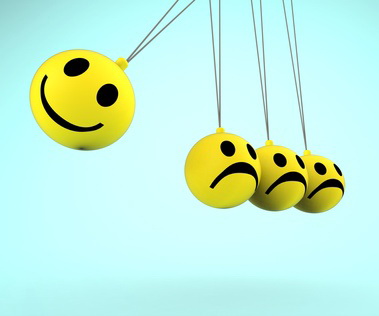
Happy And Sad Smileys Showing EmotionsHave you smiled today? One of the best ways to change your day is to change your mood.  And one of the easiest ways to do that is very simple: Just smile!

Go ahead – smile.  Relax into it.  Let the act of smiling wash over you.

If you struggle with this, try asking yourself one of these questions (or come up with one of your own):


→ What word makes me smile?  (You will think of one – then think about that word and smile!)

→ What person makes me smile? (You will think of someone – think about them and smile!)

→ What music makes me smile (You will have a favorite – play it back and smile!)

→ What place makes me smile (We all have a place – remember yours and smile!)

One of those questions is going to bring a thought to mind that will inspire your smile.  Hold that thought as you relax into the smile.

Here’s what will happen when you do:

🙂 Your stress level will go down (and so will your blood pressure!).

🙂 You will live longer (studies prove it…).

🙂 Your health will improve (more studies prove this…) and your immune system will work better.

🙂 You will simply feel better (studies show that smiling releases endorphins, natural pain killers and serotonin).

🙂 You will stand out from the crowd (nothing is more magnetic than a smile).

🙂 People are going to smile back!  It is one of the most contagious expressions that exists and you can change their day as you’re changing your own.

So go ahead – make your day (and mine!): Smile!

How do you see yourself? You might need to break the mirror..

Broken MirrorPerspective is a powerful thing.  The key to understanding just how powerful is knowing that we do not see what is there.  We see what we expect to be there.  This is also true about ourselves.  We do not see who we really are.  We see who we expect ourselves to be.  And those expectations create our perspective about everything.

Think about a trip to the fun house and going through the House of Mirrors.  When you see yourself in those mirrors, you know it isn’t who you really are.  And yet that is still who you appear to be.  The fact is, many of us see a distorted image of ourselves just like in the fun house mirrors rather than our true selves. And it changes how we see everything about our possibilities.

Where that distorted sense of self comes from is different for all of us.  But no matter what is at its root, there is only one way to change it.  We need a new mirror.  A true mirror.  A mirror that shows us who we really are.  That takes courage.  We have to be willing to let go of the fun house reflection in order to get to what is real and true.

So the next time you think that you are not enough or that you are too much, check for a fun house mirror. Because it’s there. And there is nothing fun about it.  It’s okay to break that mirror.  No bad luck involved.  In fact, just the opposite.

Breaking that mirror will mean you will see a new mirror.  A mirror that will clearly reflect the best of you and your possibilities. That’s the mirror to keep.


The best laid plans…

Cancelled Flights Departures BoardIt is not enough to know ourselves.

We need to be compelled to develop our personal best by practicing life skills that in changing us change our interactions and influence in the world in a meaningful way.

After all, those best laid plans are just that, only plans.  It is in the execution that we discover and enjoy the best experience.

When we master life skills within our daily practices that allow us to cope with disruptions and detours we are laying a firm foundation for personal success.  A key word reference in that statement is skills.  True skill (mastery) develops when we practice something relentlessly in order to do it well.  Coping skills are no different.

Let’s consider some questions and situations to bring focus to this:

How resourceful are you when something does not work as planned in your day?  Someone does not show up for a meeting.  You burn dinner.  Your printer won’t print.  How do you put that “new found time” to work? How do you transform disappointment and frustration into something else? How do you change gears and get the job done another way?

How value sensitive are you when disruptions come that matter more than what you had planned? A child needs your attention. Are you able to see beyond an interruption to need? A friend calls and needs your shoulder. Can you balance values and time? A colleague needs your help. Are you able to serve first?

How agile are you in shifting your mental focus?  Are you mentally and physically present? Does the disruption feel more like a distraction? To you? To the other person?

How resilient are you in getting back on track?  The alarm didn’t work and now you’re late. How do you handle it? That phone call with a friend took an hour of your time. How do you re-enter the planned schedule?

These are all life skills that are formed in our day to day encounters and experience. How we handle these scenarios is a preview of how we’ll handle the more significant disruptions.  Our life will go the way that our days go.

When you think about the last few days, focus in one 3 or 4 moments when one of the above situations or something like them happened.  Replay that situation as a mind movie and consider how you could have improved or enhanced the outcome. Determine how you can be mindful of those options when the situation reoccurs (because it will!).

As we wrap for today, here are some thoughts from a few people with experience in life’s coping skills to inspire and help you in your quest.

“In the long run, we shape our lives and we shape ourselves. The process never ends until we die. And the choices we make are ultimately our own responsibility.”  -Eleanor Roosevelt

 “Skill to do comes of doing.” -Ralph Waldo Emerson

 “It’s not enough that we do our best; sometimes we have to do what’s required.” -Winston Churchill

How to finally get (and stay) free of life’s “dust collectors”

Time For Organize, Business Concept.One year ago I began what initially felt like a herculean task to bring order to my home and office.  I was determined that every room, every closet, every shelf, every cabinet, every drawer would be cleared-out of anything and everything that did not need to be there. I was determined to free myself from clutter. All kinds.

In addition to the undertaking to create order, I also set a goal for myself to give away or donate at least one box or bag of items every week for the first six months.  It was my desire to create an incentive to be less attached to things and to create more breathing space in my environment.

Clean-up and clear-out. And it worked. At first.

Somewhere along the way it stopped working. Why? It stopped because I did.  I considered it temporary work.  It was a project with a definite beginning and a definite end.  That meant it was really just temporary behavior. I never created a commitment to a routine, only to a project.

I can’t argue that I did make great progress.  There is no question that where I am now vs. a year ago is improved. I can argue that I didn’t really change.  Because where I am vs. six months ago is not improved. That is the issue. And six months from now, I will be right back where I was a year ago unless I do change.

This is an example of why we need to look at our daily behaviors when we really want to effect permanent change.  This year I am taking a different approach.  This time my focus is on my daily schedule and putting an organization activity on my agenda every day. That allows me to activate several over the course of a week and a more significant number each month. It also keeps me cycled (and recycled) every month so that the actual work is less. The piles are less daunting, the lists are shorter.  I am not starting a project. I am creating better habits.

Imagine spending just 15 minutes a day over the next 30 days focused on clearing something out.  Then create a list of everywhere that you know requires continuous monitoring and start there. A few ideas to consider (from my list..) might be your e-mail in-box and other folders; your postal service mail baskets and personal papers/bills; your business filing and paperwork; your pantry; your refrigerator; cleaning supplies, and, yes, that infamous junk drawer that we all have.  These are not “once and done” places.  And there are other things to consider.  These are the “dust collectors” that we have to stay on top of to keep a healthy and productive environment.

Change happens with ease when our mindset is open, our motivation is compelling and the method we’ve chosen is effective for us.  I had the right mindset and a compelling motivation.  But I chose a method that worked for other people but not for me.  That’s okay because sometimes (most times in fact) it takes a few tries to find the absolute best method.  Even when we find it, we also know it’s going to change over time because we are growing and changing as a person and our daily practices need to keep pace.

This weekend begins my new approach.  It feels very different.  Not herculean at all. In fact, it feels just right!  Daily practices are the key.  I am continually reminded that to have the “me” I want tomorrow I must live that “me” today.  To have the business I want tomorrow, I must practice that business today.  To have the order I want tomorrow, I must create that order today.  Every day.

Live today like you want tomorrow to be.

What one change in your living or working environment would you like to have in your future? How can you begin today to create it?  Are you ready? Let’s get started!

Setting up for success – Five R’s that make a difference

One of my favorite roles when I worked in corporate management was mentoring young managers coming into the group. Being a part of setting them up for success was very rewarding. As a mentor, what we share is the result of proven experience. To mentor, you need to have succeeded and you need to have failed.  It is the culmination of what worked and what didn’t and observations of all the “what when, why, where, and how’s” of good practices.

you can do it word banner hold in hand stock vectorThat is still one of my favorite roles now as a life strategist and mentor.  Whether we are talking about daily practices for our life or our business, many of the same principals apply.  After all, what we are looking for are the best results we can achieve from the investment of our time, energy and other resources.

There are five areas which are often over-looked that have made a significant difference for me in achieving my own goals.  They are rate, recurrence, ratio, resilience and risk. In today’s post I am sharing with you why these matter and how to begin considering them when reviewing your own daily practices.  These have been pivotal to me and changed my results every time.

Rate

The rate or pace at which we do something impacts the results.  If we rush, we might be creating a higher risk of errors.  If we go too slowly, we might potentially risk losing interest. And the rate can also affect results based on its affect on efficiency.  For example, if I want to achieve my ideal weight one of the action goals I am going to set is for certain activities every day.  Some of those need to be cardio activities that increase heart rate (safely) and cause my body’s furnace to operate at its peak.  That means the rate (or pace) is very much a factor.  Even walking that is the case.  The effect of a leisurely stroll is far different from that of a power walk.

Recurrence

How regularly we do something is also a factor.  Using our health example, if I don’t exercise with the right recurring schedule I diminish the value and get a poorer result than if the schedule is optimized. Recurring activities done properly are also what generate mastery. Remember that the majority of what we need to be able to do comes from skill, not talent.  Talent might begin it but skill is what will determine the real quality of the end result in most cases. And skill comes from relentless repetition of doing it right.

Ratio

When we talk about ratios, we are talking about the power of the relationship between certain activities. All too often we neglect this and get discouraged when we don’t see the results we want from the work we are doing. The challenge is getting those ratios right for other activities. In our health example, the obvious ratio here would be between what we are eating vs. our activities.  We have to have the ratio right to get the result.  One influences the other without question. But there are other ratios as well.  Determine what activities impact each other and optimize their ratios. When you do, you are optimizing your results as well.

Resilience

Nothing works every time all the time. It just doesn’t. There are always variables and influences that come into the picture. Our ability to be resilient and resume our daily practices is going to be major influencing factor in the ultimate success of our efforts. That is why every day matters. Each day we put ourselves back on the path to our ultimate success by the choices of that day. Whatever came before diminishes because of what we decide now. And whatever comes later is going to be the direct result of the latest decisions we’ve made.

Risk

One of the first questions we should ask when we set a new goal or objective is why we haven’t already achieved it.  If I use the healthy weight example, the question would be “why am I not at a healthy weight now”.  There is tremendous insight in this question because it helps us discover potential points of failure. Where are those risks? What steps can we take to eliminate or mitigate them? Being aware of potential threats is a vital part of our strategy.  When we know where they are we can take steps to manage them. That becomes part of our questioning thread.  For example, the question of why I am not healthy now would then prompt the next question of what I can do to remove that threat or obstacle going forward.  In my personal story, it resulted in a massive clearing out of the pantry, refrigerator and freezer and continued monitoring of what I allowed to be there.  Before we can eat healthy food we must have healthy food.  Conversely, the best ways to stop eating unhealthy food is to not have it available. It sounds simple in theory (and it is) but it requires specific action to make it happen. That is the essence of managing risk.

Rate, recurrence, ratio, resilience and risk: Can you see where one or more of these might be where you need to shift your focus in order to change your results? Sometimes it helps to have another perspective when we look at these questions.  Our laser strategy sessions are designed to help.  Are you ready to get the results you’ve been missing? Let’s chat!